






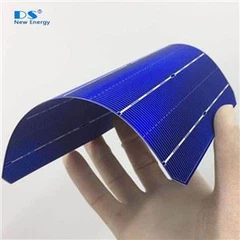



Famous solar cell efficiency tables had been updated to version 52 on 19 June 2018 in“Progress in Photovoltaics” which has published haf a year listings of the confirmed top efficiencies for various PV cell and module technologies.
Ten new results are reported in solar cell efficiency tables (version 52) ,let’s get more details.
The first new result in table 1 (single‐junction terrestrial cell and submodule efficiencies measured under the global AM1.5 spectrum) with record efficiency of 22.9% is a 1‐cm2 thin film polycrystalline CIGS (CuIn1‐xGaxSe2) solar cell fabricated by Solar Frontier.
Secondly, a record efficiency of 17.25% confirmed by the Newport PV Laboratory in table 1 is a 19‐cm2 perovskite minimodule fabricated by Microquanta Semiconductor. For perovskite cells, the tables now accept results based on “quasi‐steady‐state” measurements.
Thirdly,a new result in Table 1 with record 11.7% efficiency is a relatively large‐area 703‐cm2 perovskite submodule fabricated by Toshiba and confirmed at Japanese AIST.
The first new result in table 2 (notable exceptions) with an efficiency of 26.1% confirmed for a 4‐cm2 cell on p‐type substrate fabricated with IBC structure and combined with TOPCON technology was made by the Institute for Solar Energy Research, Hamelin and measured at the Institute's Calibration and Test Center.
A second new result in table 2 with 12.3% efficiency on a small area 0.09‐cm2 bulk heterojunction organic solar cell was fabricated at the State Key Laboratory of Polymer Physics and Chemistry of the Chinese Academy of Science and measured at Newport.
Four new results were reported in Table 3 (relating to 1‐sun, multijunction devices).
The first in table 3 is a 4‐cm2 monolithic, 2‐junction, 2‐terminal GaAsP/Si tandem device fabricated by a joint effort of Ohio State University, SolAero Technologies Corporation and the University of New South Wales, and measured at the US NREL.
Two new results with same efficiency of 25.2% had been achived in perovskite/silicon monolithic 2‐junction, 2‐terminal devices and both of them were measured at the Fraunhofer Institute for Solar Energy Systems.
A fourth new result with an efficiency of 22.4% in table 3 was measured for a small area 0.04‐cm2 perovskite/CIGS monolithic 2‐junction, 2‐terminal cell fabricated by University of California, Los Angeles and confirmed at NREL.
There is one new result reported in Table 4 (terrestrial module efficiency under the global AM1.5 spectrum). The new result was made by Toshiba with an efficiency of 11.6% for a 802‐cm2 perovskite module measured by Japanese AIST.
As we can see in the solar cell efficiency tables (version 52), 6 of the 10 new results are about perovskite solar cell or module which attract more and more attention of researchers due to the rapid progress of conversion efficiency and potential cost-effective.