Back Surface Field (BSF) solar cell technology

Back Surface Field (BSF) has been used as one of means to enhance solar cell performance by reducing surface recombination velocity (SRV). One of methods to produce BSF is by introducing highly doped layer on rear surface of the wafer.
Screen printed Aluminum and rapid thermal alloying are used together in order to get an Al back surface field (Al-BSF) that can lower the effective back surface recombination velocity. This process has been combined into a high efficiency, laboratory fabrication and a high throughput, industrial process to achieve such solar cell efficiencies in excess of 19.0% and 17.0%.
The critical process requirements for optimal formation of Al-BSF are:
Using of a fast ramp rate to reach the alloying temperature
Thick film Al deposition preceding the alloying.
The common approach for providing the p-contact for industrial p-type silicon solar cells is using Aluminum alloyed screen printed and fired rear contact.
Passivated Emitter Rear Contact (PERC) solar cell technology
To improve the number of photons that are captured by a solar cell, PERC technology adds two additional layers at the rear of the cell.

PERC solar cell
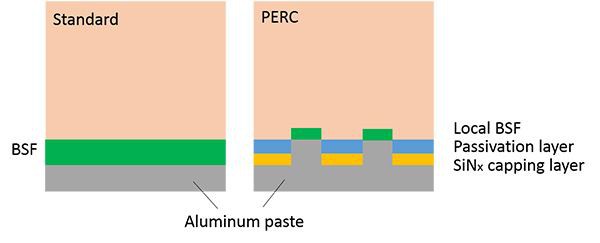
PERC (Passivated Emitter Rear Contact) technology is the combination of rear wafer surface passivation and local rear contacts, a process which delivers significant efficiency-enhancing benefits, particularly at the PV system level.
<Exceptional performance under low-light and high temperature conditions.
Higher energy density per square foot than conventional monocrystalline cells.
Increased light absorption, as unabsorbed light is reflected back to the solar cell.
Greater internal reflectivity; Reduction of electron recombination.
Those layers improve the movement of electrons in the cell, and also bounces light back into the cell, giving the cell a second chance to capture electrons that would otherwise simply pass through.The absolute gains in efficiency from PERC will vary from manufacturer to manufacturer, but you can roughly expect an absolute increase of 1% efficiency in the cell. This means that if the solar panel was 19% efficient, the use of PERC might boost that panel to 20% efficiency.
Tunnel Oxide Passivated Contact (TOPCon) solar cell technology

There’s that word “passivated” again. In fact, TOPCON technology is basically just the next generation of PERC, and like its forbear, it can be added to cells manufactured in the traditional way. TOPCon involves adding an ultra-thin layer of silicon dioxide (SiO2) and a layer of polycrystalline silicon doped with phosphorus.
Because TOPCon is the next logical step after PERC, it does not add a great deal of additional cost to the finished product. It can produce additional gains in efficiency over PERC, but its theoretical maximum efficiency is 23.7%. It’s important to note that current TOPCon technology tops out at a little over 22%, though.
Heterojunction (HJT) solar cell technology
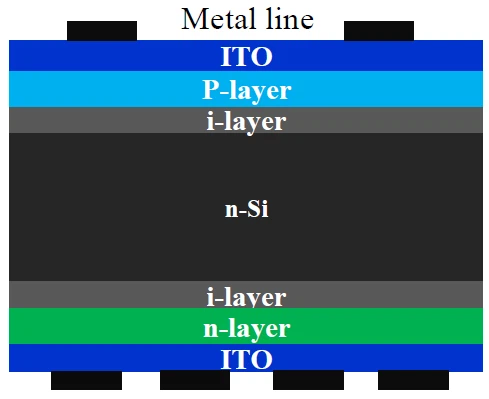
Heterojunction solar cells are made of alternating layers of traditional crystalline silicon and amorphous silicon, the latter of which is normally associated with thin-film solar panels. By combining the two different kinds of layers, HJT cells absorb more wavelengths of light, and the different layers work together to make the cells the most efficient on the market today.
Unfortunately, HJT technology cannot be made in the same way traditional solar cells can, so it requires significant re-tooling and new industrial processes. This tends to make HJT solar modules quite expensive, although they do carry a reputation for premium quality and high performance.
HJT solar cells have a theoretical maximum efficiency of greater than 26.7%, but current offerings from companies like REC Solar and Panasonic top out around 24%.
Interdigitated back contact (IBC) solar cell technology
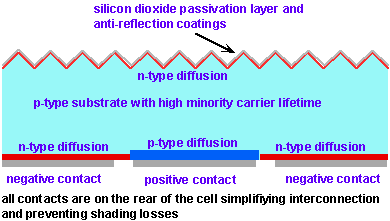
Instead of front contact energy conversion, IBC has back contact energy conversion. This allows for the entire front of the cell to absorb sunlight, without any shading from the metal ribbons, converting more photons to energy.
IBC solar cells require interdigitated (or striped) doping on the rear surface and only have contacts on the rear. This doping can be achieved by masked diffusion, masked ion-implantation or laser doping. The solar cells are then metallised by forming metal fingers along each diffused region.