

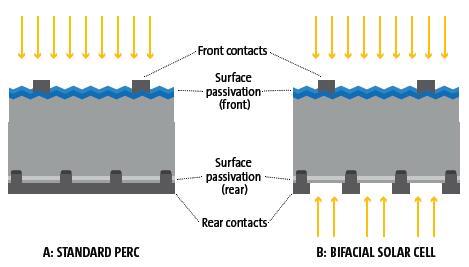
The advantage of bifacial solar panels is that it can convert both direct and reflective sunlight from the front and rear surfaces of the solar panel to produce more energy whereas the standard solar panel can only use the direct light from the panel front surface. Bifacial technology, which was developed in the 1970s, has had only a small market share due to comparatively high production costs and much more weight of dual glass structure. But nowadays as the bifacial technology advancing it get more and more popularity.
The new process for manufacturing bifacial solar cells based on the popular PERC technology which makes the bifacial cell technology more cost effective and suitable for industrial production. The bifacial module of this new generation, from the top 10 solar panel manufactures around the world, is available as a glass-glass module with 60 or 72 bifacial cells or a glass/clear backsheet module with 60 or 72 bifacial cells generating power on both sides and additional energy yield.
The size of this increase depends mainly on the reflective behavior of the surface underneath the module and the installation height of the solar power system.
Operation PRINCIPLES of bifaCIAL TECHNOLOGY
Bifacial solar cells have the advantage of producing more energy by using reflective incidental light from the rear along with light from the front of the module. With the transparent rear sides, glass-glass modules therefore provide the ideal module technology for bifacial solar cells. A second glass plate on the rear of the module allows reflected sunlight to reach the cells from the back. In this way, individual modules generate higher yields. Embedding the cells in a glass composite protects them from environmental and mechanical influences. High durability and minimal degradation ensure a maximum service life.
Bifacial cells are solar cells that are designed to allow the entry of light from both sides. They employ a standard front surface design that is very similar to the ones that are used in screen printed solar cells that are practically the industry standard. The only major difference is the structure of the rear surface. It is not covered with reflective aluminum. Instead, a finger grid is used to allow the passage of sunlight through the back.
The silicon material that they use in bifacial cells is of a much higher quality, which makes it possible for the photogenerated charges on the rear surface to contribute to the power production as they travel towards the front surface. The design also makes it necessary to use transparent materials on either side of the module.
Traditionally, bifacial cells were used in building integrated photovoltaic applications and in areas where most of the solar energy is in the form of diffused sunlight that has bounced off the ground and all the surrounding objects (snow prone areas and extreme latitudes). However, with the plateauing of peak efficiencies and cheaper solar glasses, bifacial modules are back in the limelight.
INSTALLATION HEIGHT OF THE MODULE
The installation height of the module is the second main influence on the energy yield of a bifacial module. The higher the installation height of the module, the higher the additional energy yield will be of the bifacial PV module.

However, To match the photovoltaic generation profile with the onsite demand, most of the consumers go for an north-south or east-west orientation which depends on where are they. Half of the panels are tilted towards the south or east and the other half are tilted towards the north or west, for better generation peaks in the mornings and afternoons respectively. The double peak profile better matches the electricity use onsite, especially for commercial and residential installations.
This approach will work even better if we employ vertically installed bifacial modules, which would cut down the number of required modules by more than half. Not only will this setup benefit from the two generation peaks, it will also benefit from all the diffuse light that enters the module from the indirect side.
An optimal combination of reflective surface and the highest possible system height makes it possible to achieve an additional energy yield of up to 25 percent.
COST COMPARISON
When comparing the financial merits of bifacial solar panels against single-sided modules, we should consider the leveled cost of electricity and not just the dollars-per-watt cost of the respective modules. For photovoltaic consumers who are connected to the grid, the ability to match the onsite demand with the photovoltaic generation profiles – thereby maximizing the use of the generated photovoltaic electricity rather than feeding it back into the American grids at a reduced rate – can significantly boost the returns on solar panel investment, in spite of the slightly higher upfront cost of the bifacial solar module. You get a better bell curve distribution of generated power and the maintenance costs are pretty much the same. So, if you are planning to go for one, it helps to know that the benefits clearly outweigh the drawbacks.