From: www.onlinelibrary.wiley.com
1 INTRODUCTION
Since January 1993, “Progress in Photovoltaics” has published six monthly listings of the highest confirmed efficiencies for a range of photovoltaic cell and module technologies.1-3By providing guidelines for inclusion of results into these tables, this not only provides an authoritative summary of the current state‐of‐the‐art but also encourages researchers to seek independent confirmation of results and to report results on a standardised basis. In Version 33 of these tables,3 results were updated to the new internationally accepted reference spectrum (International Electrotechnical Commission IEC 60904‐3, Ed. 2, 2008).
The most important criterion for inclusion of results into the tables is that they must have been independently measured by a recognised test centre listed elsewhere.2 A distinction is made between three different eligible definitions of cell area: total area, aperture area, and designated illumination area, as also defined elsewhere2 (note that, if masking is used, masks must have a simple aperture geometry, such as square, rectangular, or circular). “Active area” efficiencies are not included. There are also certain minimum values of the area sought for the different device types (above 0.05 cm2 for a concentrator cell, 1 cm2 for a one‐sun cell, 800 cm2 for a module and 200 cm2 for a “submodule”).
Results are reported for cells and modules made from different semiconductors and for sub‐categories within each semiconductor grouping (eg, crystalline, polycrystalline, and thin film). From Version 36 onwards, spectral response information is included (when possible) in the form of a plot of the external quantum efficiency (EQE) versus wavelength, either as absolute values or normalised to the peak measured value. Current‐voltage (IV) curves have also been included where possible from Version 38 onwards. A graphical summary of progress over the first 25 years during which the tables have been published has been included in Version 51.2
Highest confirmed “one sun” cell and module results are reported in Tables 1-4. Any changes in the tables from those previously published1 are set in bold type. In most cases, a literature reference is provided that describes either the result reported, or a similar result (readers identifying improved references are welcome to submit to the lead author). Table 1summarizes the best‐reported measurements for “one‐sun” (non‐concentrator) single‐junction cells and submodules.
Table 1. Confirmed single‐junction terrestrial cell and submodule efficiencies measured under the global AM1.5 spectrum (1000 W/m2) at 25°C (IEC 60904‐3: 2008, ASTM G‐173‐03 global)| Classification | Efficiency, % | Area, cm2 | Voc, V | Jsc, mA/cm2 | Fill Factor, % | Test Centre (date) | Description |
|---|
| Silicon |
| Si (crystalline cell) | 26.7 ± 0.5 | 79.0 (da) | 0.738 | 42.65a | 84.9 | AIST (3/17) | Kaneka, n‐type rear IBC4 |
| Si (multicrystalline cell) | 22.3 ± 0.4b | 3.923 (ap) | 0.6742 | 41.08c | 80.5 | FhG‐ISE (8/17) | FhG‐ISE, n‐type5 |
| Si (thin transfer submodule) | 21.2 ± 0.4 | 239.7 (ap) | 0.687d | 38.50d,e | 80.3 | NREL (4/14) | Solexel (35 μm thick)6 |
| Si (thin film minimodule) | 10.5 ± 0.3 | 94.0 (ap) | 0.492d | 29.7d,f | 72.1 | FhG‐ISE (8/07) | CSG Solar (<2 μm on glass)7 |
| III‐V cells |
| GaAs (thin film cell) | 29.1 ± 0.6 | 0.998 (ap) | 1.1272 | 29.78g | 86.7 | FhG‐ISE (10/18) | Alta Devices8 |
| GaAs (multicrystalline) | 18.4 ± 0.5 | 4.011 (t) | 0.994 | 23.2 | 79.7 | NREL (11/95) | RTI, Ge substrate9 |
| InP (crystalline cell) | 24.2 ± 0.5b | 1.008 (ap) | 0.939 | 31.15a | 82.6 | NREL (3/13) | NREL10 |
| Thin film chalcogenide |
| CIGS (cell) | 22.9 ± 0.5 | 1.041 (da) | 0.744 | 38.77h | 79.5 | AIST (11/17) | Solar Frontier11, 12 |
| CdTe (cell) | 21.0 ± 0.4 | 1.0623 (ap) | 0.8759 | 30.25e | 79.4 | Newport (8/14) | First Solar, on glass13 |
| CZTSSe (cell) | 11.3 ± 0.3 | 1.1761 (da) | 0.5333 | 33.57g | 63.0 | Newport (10/18) | DGIST, Korea14 |
| CZTS (cell) | 10.0 ± 0.2 | 1.113 (da) | 0.7083 | 21.77a | 65.1 | NREL (3/17) | UNSW15 |
| Amorphous/microcrystalline |
| Si (amorphous cell) | 10.2 ± 0.3i,b | 1.001 (da) | 0.896 | 16.36e | 69.8 | AIST (7/14) | AIST16 |
| Si (microcrystalline cell) | 11.9 ± 0.3b | 1.044 (da) | 0.550 | 29.72a | 75.0 | AIST (2/17) | AIST16 |
| Perovskite |
| Perovskite (cell) | 20.9 ± 0.7i,j | 0.991 (da) | 1.125 | 24.92c | 74.5 | Newport (7/17) | KRICT17 |
| Perovskite (minimodule) | 17.25 ± 0.6j,l | 17.277 (da) | 1.070d | 20.66d,h | 78.1 | Newport (5/18) | Microquanta, 7 serial cells18 |
| Perovskite (submodule) | 11.7 ± 0.4i | 703 (da) | 1.073d | 14.36d,h | 75.8 | AIST (3/18) | Toshiba, 44 serial cells19 |
| Dye sensitised |
| Dye (cell) | 11.9 ± 0.4j,k | 1.005 (da) | 0.744 | 22.47n | 71.2 | AIST (9/12) | Sharp20 |
| Dye (minimodule) | 10.7 ± 0.4j,l | 26.55 (da) | 0.754d | 20.19d,o | 69.9 | AIST (2/15) | Sharp, 7 serial cells21 |
| Dye (submodule) | 8.8 ± 0.3j | 398.8 (da) | 0.697d | 18.42d,p | 68.7 | AIST (9/12) | Sharp, 26 serial cells22 |
| Organic |
| Organic (cell) | 11.2 ± 0.3q | 0.992 (da) | 0.780 | 19.30e | 74.2 | AIST (10/15) | Toshiba23 |
| Organic (minimodule) | 9.7 ± 0.3q | 26.14 (da) | 0.806d | 16.47d,o | 73.2 | AIST (2/15) | Toshiba (8 series cells)23 |
Abbreviations: AIST, Japanese National Institute of Advanced Industrial Science and Technology; (ap), aperture area; a‐Si, amorphous silicon/hydrogen alloy; CIGS, CuIn1‐yGaySe2; CZTS, Cu2ZnSnS4; CZTSSe, Cu2ZnSnS4‐ySey; (da), designated illumination area; FhG‐ISE, Fraunhofer Institut für Solare Energiesysteme; nc‐Si, nanocrystalline or microcrystalline silicon; (t), total area.
a Spectral response and current‐voltage curve reported in Version 50 of these tables.
b Not measured at an external laboratory.
c Spectral response and current‐voltage curve reported in Version 51 of these tables.
d Reported on a “per cell” basis.
e Spectral responses and current‐voltage curve reported in Version 45 of these tables.
f Recalibrated from original measurement.
g Spectral response and current‐voltage curve reported in the present version of these tables.
h Spectral response and current‐voltage curve reported in Version 52 of these tables.
i Stabilized by 1000‐h exposure to 1 sun light at 50 C.
j Initial performance. References 67, 68 review the stability of similar devices.
k Average of forward and reverse sweeps at 150 mV/s (hysteresis ± 0.26%).
l Measured using 13 point IV sweep with constant bias until data constant at 0.05% level.
m Initial efficiency. Reference 71 reviews the stability of similar devices.
n Spectral response and current‐voltage curve reported in Version 41 of these tables.
o Spectral response and current‐voltage curve reported in Version 46 of these tables.
p Spectral response and current‐voltage curve reported in Version 43 of these tables.
q Initial performance. References 69, 70 review the stability of similar devices.
Table 2. “Notable exceptions” for single‐junction cells and submodules: “Top dozen” confirmed results, not class records, measured under the global AM1.5 spectrum (1000 Wm−2) at 25°C (IEC 60904–3: 2008, ASTM G‐173‐03 global)| Classification | Efficiency, % | Area, cm2 | Voc, V | Jsc, mA/cm2 | Fill Factor, % | Test Centre (Date) | Description |
|---|
| Cells (silicon) |
| Si (crystalline) | 25.0 ± 0.5 | 4.00 (da) | 0.706 | 42.7a | 82.8 | Sandia (3/99)b | UNSW p‐type PERC top/rear contacts24 |
| Si (crystalline) | 25.8 ± 0.5c | 4.008 (da) | 0.7241 | 42.87d | 83.1 | FhG‐ISE (7/17) | FhG‐ISE, n‐type top/rear contacts25 |
| Si (crystalline) | 26.1 ± 0.3c | 3.9857 (da) | 0.7266 | 42.62e | 84.3 | ISFH (2/18) | ISFH, p‐type rear IBC26 |
| Si (large) | 26.6 ± 0.5 | 179.74 (da) | 0.7403 | 42.5f | 84.7 | FhG‐ISE (11/16) | Kaneka, n‐type rear IBC4 |
| Si (multicrystalline) | 22.0 ± 0.4 | 245.83 (t) | 0.6717 | 40.55d | 80.9 | FhG‐ISE (9/17) | Jinko solar, large p‐type27 |
| Cells (III‐V) |
| GaInP | 21.4 ± 0.3 | 0.2504 (ap) | 1.4932 | 16.31g | 87.7 | NREL (9/16) | LG electronics, high bandgap28 |
| GaInAsP/GaInAs | 32.6 ± 1.4c | 0.248 (ap) | 2.024 | 19.51d | 82.5 | NREL (10/17) | NREL, monolithic tandem29 |
| Cells (chalcogenide) |
| CdTe (thin‐film) | 22.1 ± 0.5 | 0.4798 (da) | 0.8872 | 31.69h | 78.5 | Newport (11/15) | First solar on glass30 |
| CZTSSe (thin‐film) | 12.6 ± 0.3 | 0.4209 (ap) | 0.5134 | 35.21i | 69.8 | Newport (7/13) | IBM solution grown31 |
| CZTSSe (thin‐film) | 12.6 ± 0.3 | 0.4804 (da) | 0.5411 | 35.39 | 65.9 | Newport (10/18) | DGIST, Korea14 |
| CZTS (thin‐film) | 11.0 ± 0.2 | 0.2339(da) | 0.7306 | 21.74f | 69.3 | NREL (3/17) | UNSW on glass32 |
| Cells (other) |
| Perovskite (thin‐film) | 23.7 ± 0.8j,k | 0.0739 (ap) | 1.1697 | 25.40l | 79.8 | Newport (9/18) | ISCAS, Beijing33 |
| Organic (thin‐film) | 15.6 ± 0.2m | 0.4113 (da) | 0.8381 | 25.03l | 74.5 | NREL (11/18) | Sth China U. ‐ Central Sth U.34 |
Abbreviations: AIST, Japanese National Institute of Advanced Industrial Science and Technology; (ap), aperture area; CIGSSe, CuInGaSSe; CZTS, Cu2ZnSnS4; CZTSSe, Cu2ZnSnS4‐ySey; (da), designated illumination area; FhG‐ISE, Fraunhofer‐Institut für Solare Energiesysteme; ISFH, Institute for Solar Energy Research, Hamelin; NREL, National Renewable Energy Laboratory; (t), total area.
a Spectral response reported in Version 36 of these tables.
b Recalibrated from original measurement.
c Not measured at an external laboratory.
d Spectral response and current‐voltage curves reported in Version 51 of these tables.
e Spectral response and current–voltage curve reported in Version 52 of these tables.
f Spectral response and current‐voltage curves reported in Version 50 of these tables.
g Spectral response and current‐voltage curves reported in Version 49 of these tables.
h Spectral response and/or current‐voltage curves reported in Version 46 of these tables.
i Spectral response and current‐voltage curves reported in Version 44 of these tables.
j Stability not investigated. References 69, 70 document stability of similar devices.
k Measured using 13‐point IV sweep with constant voltage bias until current determined as unchanging.
l Spectral response and current‐voltage curve reported in the present version of these tables.
m Long‐term stability not investigated. References 69, 70 document stability of similar devices.
Table 3. Confirmed multiple‐junction terrestrial cell and submodule efficiencies measured under the global AM1.5 spectrum (1000 W/m2) at 25°C (IEC 60904‐3: 2008, ASTM G‐173‐03 global)| Classification | Efficiency, % | Area, cm2 | Voc, V | Jsc, mA/cm2 | Fill Factor, % | Test Centre (Date) | Description |
|---|
| III‐V multijunctions |
| 5 junction cell (bonded) | 38.8 ± 1.2 | 1.021 (ap) | 4.767 | 9.564 | 85.2 | NREL (7/13) | Spectrolab, 2‐terminal35 |
| (2.17/1.68/1.40/1.06/0.73 eV) |
| InGaP/GaAs/InGaAs | 37.9 ± 1.2 | 1.047 (ap) | 3.065 | 14.27a | 86.7 | AIST (2/13) | Sharp, 2 term.36 |
| GaInP/GaAs (monolithic) | 32.8 ± 1.4 | 1.000 (ap) | 2.568 | 14.56b | 87.7 | NREL (9/17) | LG electronics, 2 term. |
| Multijunctions with c‐Si |
| GaInP/GaAs/Si (mech. stack) | 35.9 ± 0.5c | 1.002 (da) | 2.52/0.681 | 13.6/11.0 | 87.5/78.5 | NREL (2/17) | NREL/CSEM/EPFL, 4‐term.37 |
| GaInP/GaAs/Si (wafer bonded) | 33.3 ± 1.2c | 3.984 (ap) | 3.127b | 12.7b | 83.5 | FhG‐ISE (8/17) | Fraunhofer ISE, 2‐term.38 |
| GaInP/GaAs/Si (monolithic) | 22.3 ± 0.8c | 0.994 (ap) | 2.619 | 10.0d | 85.0 | FhG‐ISE(10/18) | Fraunhofer ISE, 2‐term.39 |
| GaAsP/Si (monolithic) | 20.1 ± 1.3 | 3.940 (ap) | 1.673 | 14.94e | 80.3 | NREL (5/18) | OSU/SolAero/UNSW, 2‐term. |
| GaAs/Si (mech. Stack) | 32.8 ± 0.5c | 1.003 (da) | 1.09/0.683 | 28.9/11.1e | 85.0/79.2 | NREL (12/16) | NREL/CSEM/EPFL, 4‐term.37 |
| Perovskite/Si (monolithic) | 27.3 ± 0.8f | 1.090 (da) | 1.813 | 19.99d | 75.4 | FhG‐ISE (6/18) | Oxford PV40 |
| GaInP/GaInAs/Ge, Si (spectral split minimodule) | 34.5 ± 2.0 | 27.83 (ap) | 2.66/0.65 | 13.1/9.3 | 85.6/79.0 | NREL (4/16) | UNSW/Azur/Trina, 4‐term.41 |
| a‐Si/nc‐Si multijunctions |
| a‐Si/nc‐Si/nc‐Si (thin‐film) | 14.0 ± 0.4g,c | 1.045 (da) | 1.922 | 9.94h | 73.4 | AIST (5/16) | AIST, 2‐term.42 |
| a‐Si/nc‐Si (thin‐film cell) | 12.7 ± 0.4g,c | 1.000(da) | 1.342 | 13.45i | 70.2 | AIST (10/14) | AIST, 2‐term.16 |
| Notable exception |
| Perovskite/CIGSj | 22.4 ± 1.9f | 0.042 (da) | 1.774 | 17.3g | 73.1 | NREL (11/17) | UCLA, 2‐term.43 |
| GaInP/GaAs/GaInAs | 37.8 ± 1.4 | 0.998 (ap) | 3.013 | 14.60d | 85.8 | NREL (1/18) | Microlink (ELO)44 |
Abbreviations: AIST, Japanese National Institute of Advanced Industrial Science and Technology; (ap), aperture area; a‐Si, amorphous silicon/hydrogen alloy; (da), designated illumination area; FhG‐ISE, Fraunhofer Institut für Solare Energiesysteme; nc‐Si, nanocrystalline or microcrystalline silicon; (t), total area.
a Spectral response and current‐voltage curve reported in Version 42 of these tables.
b Spectral response and current‐voltage curve reported in the Version 51 of these tables.
c Not measured at an external laboratory.
d Spectral response and current‐voltage curve reported in the present version of these tables.
e Spectral response and current‐voltage curve reported in Version 50 or 52 of these tables.
f Initial efficiency. References 67, 68 review the stability of similar perovskite‐based devices.
g Stabilized by 1000‐h exposure to 1 sun light at 50 C.
h Spectral response and current‐voltage curve reported in Version 49 of these tables.
i Spectral responses and current‐voltage curve reported in Version 45 of these tables.
j Area too small to qualify as outright class record.
Table 4. Confirmed terrestrial module efficiencies measured under the global AM1.5 spectrum (1000 W/m2) at a cell temperature of 25°C (IEC 60904‐3: 2008, ASTM G‐173‐03 global)| Classification | Effic., % | Area, cm2 | Voc, V | Isc, A | FF, % | Test Centre (Date) | Description |
|---|
| Si (crystalline) | 24.4 ± 0.5 | 13177 (da) | 79.5 | 5.04a | 80.1 | AIST (9/16) | Kaneka (108 cells)4 |
| Si (multicrystalline) | 19.9 ± 0.4 | 15143 (ap) | 78.87 | 4.795a | 79.5 | FhG‐ISE (10/16) | Trina solar (120 cells)45 |
| GaAs (thin film) | 25.1 ± 0.8 | 866.45 (ap) | 11.08 | 2.303b | 85.3 | NREL (11/17) | Alta devices46 |
| CIGS (Cd free) | 19.2 ± 0.5 | 841 (ap) | 48.0 | 0.456b | 73.7 | AIST (1/17) | Solar frontier (70 cells)47 |
| CdTe (thin‐film) | 18.6 ± 0.5 | 7038.8 (da) | 110.6 | 1.533d | 74.2 | NREL (4/15) | First solar, monolithic48 |
| a‐Si/nc‐Si (tandem) | 12.3 ± 0.3f | 14322 (t) | 280.1 | 0.902f | 69.9 | ESTI (9/14) | TEL solar, Trubbach labs49 |
| Perovskite | 11.6 ± 0.4g | 802 (da) | 23.79 | 0.577h | 68.0 | AIST (4/18) | Toshiba (22 cells)19 |
| Organic | 8.7 ± 0.3g | 802 (da) | 17.47 | 0.569d | 70.4 | AIST (5/14) | Toshiba23 |
| Multijunction |
| InGaP/GaAs/InGaAs | 31.2 ± 1.2 | 968 (da) | 23.95 | 1.506 | 83.6 | AIST (2/16) | Sharp (32 cells)50 |
| Notable exception |
| CIGS (large) | 15.7 ± 0.5 | 9703 (ap) | 28.24 | 7.254i | 72.5 | NREL (11/10) | Miasole51 |
Abbreviations: (ap), aperture area; a‐Si, amorphous silicon/hydrogen alloy; a‐SiGe, amorphous silicon/germanium/hydrogen alloy; CIGSS, CuInGaSSe; (da), designated illumination area; Effic., efficiency; FF, fill factor; nc‐Si, nanocrystalline or microcrystalline silicon; (t), total area.
a Spectral response and current voltage curve reported in Version 49 of these tables.
b Spectral response and current‐voltage curve reported in Version 50 or 51 of these tables.
c Spectral response and/or current‐voltage curve reported in Version 47 of these tables.
d Spectral response and current‐voltage curve reported in Version 45 of these tables.
e Stabilised at the manufacturer to the 2% level following IEC procedure of repeated measurements.
f Spectral response and/or current‐voltage curve reported in Version 46 of these tables.
g Initial performance. References 67, 70 review the stability of similar devices.
h Spectral response and current‐voltage curve reported in the present version of these tables.
i Spectral response reported in Version 37 of these tables.
Table 2 contains what might be described as “notable exceptions” for “one‐sun” single‐junction cells and submodules in the above category. While not conforming to the requirements to be recognized as a class record, the devices in Table 2 have notable characteristics that will be of interest to sections of the photovoltaic community, with entries based on their significance and timeliness. To encourage discrimination, the table is limited to nominally 12 entries with the present authors having voted for their preferences for inclusion. Readers who have suggestions of notable exceptions for inclusion into this or subsequent tables are welcome to contact any of the authors with full details. Suggestions conforming to the guidelines will be included on the voting list for a future issue.
Table 3 was first introduced in Version 49 of these tables and summarizes the growing number of cell and submodule results involving high efficiency, one‐sun multiple‐junction devices (previously reported in Table 1). Table 4 shows the best results for one‐sun modules, both single and multiple junction, while Table 5 shows the best results for concentrator cells and concentrator modules. A small number of “notable exceptions” are also included in Tables 3-5.
Table 5. Terrestrial concentrator cell and module efficiencies measured under the ASTM G‐173‐03 direct beam AM1.5 spectrum at a cell temperature of 25°C| Classification | Effic., % | Area, cm2 | Intensitya, suns | Test Centre (Date) | Description |
|---|
| Single cells |
| GaAs | 30.5 ± 1.0b | 0.10043 (da) | 258 | NREL (10/18) | NREL, 1‐junction |
| Si | 27.6 ± 1.2c | 1.00 (da) | 92 | FhG‐ISE (11/04) | Amonix back‐contact52 |
| CIGS (thin‐film) | 23.3 ± 1.2d,e | 0.09902 (ap) | 15 | NREL (3/14) | NREL53 |
| Multijunction cells |
| GaInP/GaAs, GaInAsP/GaInAs | 46.0 ± 2.2f | 0.0520 (da) | 508 | AIST (10/14) | Soitec/CEA/FhG‐ISE 4j bonded54 |
| GaInP/GaAs/GaInAs/GaInAs | 45.7 ± 2.3d,g | 0.09709 (da) | 234 | NREL (9/14) | NREL, 4j monolithic55 |
| InGaP/GaAs/InGaAs | 44.4 ± 2.6h | 0.1652 (da) | 302 | FhG‐ISE (4/13) | Sharp, 3j inverted metamorphic56 |
| GaInAsP/GaInAs | 35.5 ± 1.2i,d | 0.10031 (da) | 38 | NREL (10/17) | NREL 2‐junction (2j) |
| Minimodule |
| GaInP/GaAs, GaInAsP/GaInAs | 43.4 ± 2.4d,j | 18.2 (ap) | 340k | FhG‐ISE (7/15) | Fraunhofer ISE 4j (lens/cell)57 |
| Submodule |
| GaInP/GaInAs/Ge, Si | 40.6 ± 2.0j | 287 (ap) | 365 | NREL (4/16) | UNSW 4j split spectrum58 |
| Modules |
| Si | 20.5 ± 0.8d | 1875 (ap) | 79 | Sandia (4/89)l | Sandia/UNSW/ENTECH (12 cells)59 |
| Three junction (3j) | 35.9 ± 1.8m | 1092 (ap) | N/A | NREL (8/13) | Amonix60 |
| Four junction (4j) | 38.9 ± 2.5n | 812.3 (ap) | 333 | FhG‐ISE (4/15) | Soitec61 |
| “Notable exceptions” |
| Si (large area) | 21.7 ± 0.7 | 20.0 (da) | 11 | Sandia (9/90)k | UNSW laser grooved62 |
| Luminescent minimodule | 7.1 ± 0.2 | 25(ap) | 2.5k | ESTI (9/08) | ECN Petten, GaAs cells63 |
| 4j minimodule | 41.4 ± 2.6d | 121.8 (ap) | 230 | FhG‐ISE (9/18) | FhG‐ISE, 10 cells57 |
Abbreviations: (ap), aperture area; CIGS, CuInGaSe2; (da), designated illumination area; Effic., efficiency; FhG‐ISE, Fraunhofer‐Institut für Solare Energiesysteme; NREL, National Renewable Energy Laboratory.
a One sun corresponds to direct irradiance of 1000 Wm−2.
b Spectral response and current‐voltage curve reported in the present version of these tables.
c Measured under a low aerosol optical depth spectrum similar to ASTM G‐173‐03 direct72.
d Not measured at an external laboratory.
e Spectral response and current‐voltage curve reported in Version 44 of these tables.
f Spectral response and current‐voltage curve reported in Version 45 of these tables.
g Spectral response and current‐voltage curve reported in Version 46 of these tables.
h Spectral response and current‐voltage curve reported in Version 42 of these tables.
i Spectral response and current‐voltage curve reported in Version 51 of these tables.
j Determined at IEC 62670‐1 CSTC reference conditions.
k Geometric concentration.
l Recalibrated from original measurement.
m Referenced to 1000 W/m2 direct irradiance and 25°C cell temperature using the prevailing solar spectrum and an in‐house procedure for temperature translation.
n Measured under IEC 62670‐1 reference conditions following the current IEC power rating draft 62670‐3.
2 NEW RESULTS
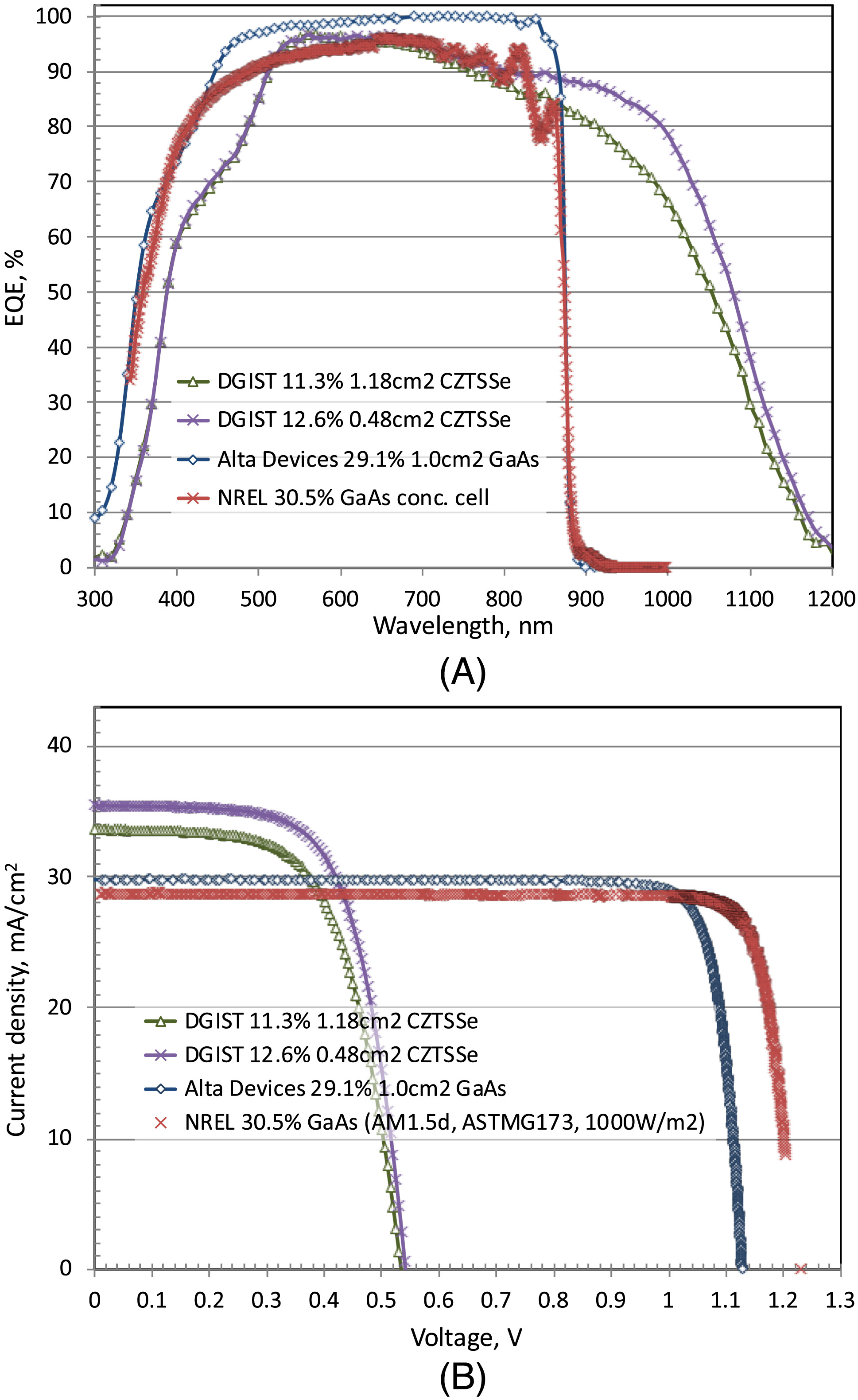
Ten new results are reported in the present version of these tables. The first new result in Table 1 (one‐sun cells) represents an outright record for any single‐junction solar cell. An efficiency of 29.1% was measured for a 1‐cm2 GaAs cell fabricated by Alta Devices8 and measured at the Fraunhofer Institute for Solar Energy Systems (FhG‐ISE).
The second new result is an efficiency of 11.3% measured for a 1.2‐cm2 CZTSSe (Cu2ZnSnSxSe4‐x) solar cell fabricated by Daegu Gyeongbuk Institute of Science and Technology (DGIST), Korea14 and measured by the Newport PV Laboratory.
The first of three new results in Table 2 (one‐sun “notable exceptions”) equals the previous record for a small area CZTSSe cell. An efficiency of 12.6% was measured also at Newport for a 0.48‐cm2 cell again fabricated by DGIST. Cell area is too small for classification as an outright record, with solar cell efficiency targets in governmental research programs generally specified in terms of a cell area of 1‐cm2 or larger.64-66
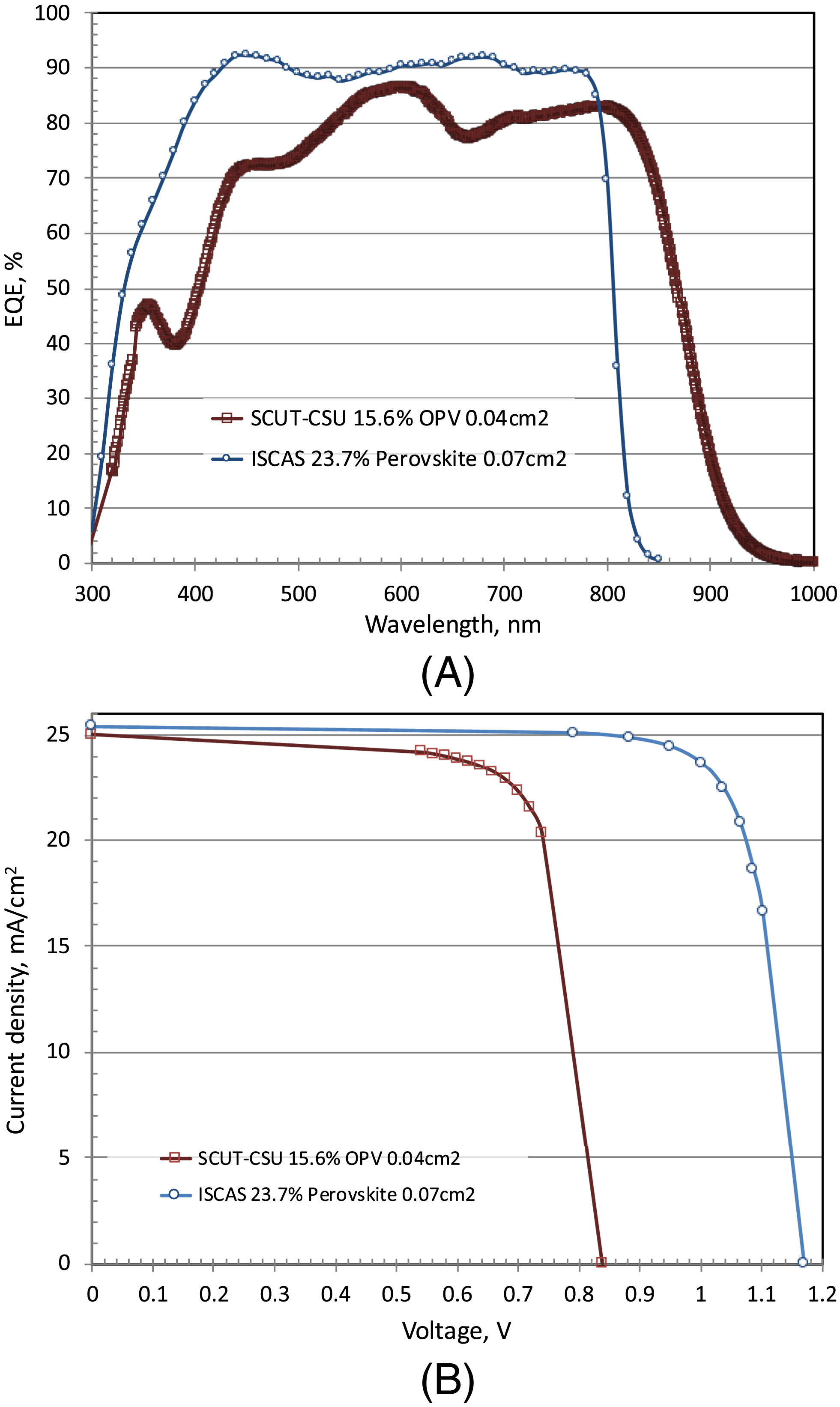
The second new result in Table 2 represents a new record for a Pb‐halide perovskite solar cell, with an efficiency of 23.7% confirmed for a small area 0.07‐cm2 cell fabricated by the Institute for Semiconductors of the Chinese Academy of Sciences (ISCAS), Beijing33 and measured at Newport.
For perovskite cells, the tables now accept results based on “quasi‐steady‐state” measurements (sometimes called “stablilised” in the perovskite field, although this conflicts with usage in other areas of photovoltaics). Along with other emerging technologies, perovskite cells may not demonstrate the same level of stability as conventional cells, with the stability of perovskite cells discussed elsewhere.67, 68
A third new “notable exception” in Table 2 is 13.3% for a very small area 0.04‐cm2 organic solar cell fabricated by South China University and Central South University34 and measured at the National Renewable Energy Laboratory (NREL). The stability of organic solar cells is discussed elsewhere69, 70 with cell area again too small for classification as an outright record.
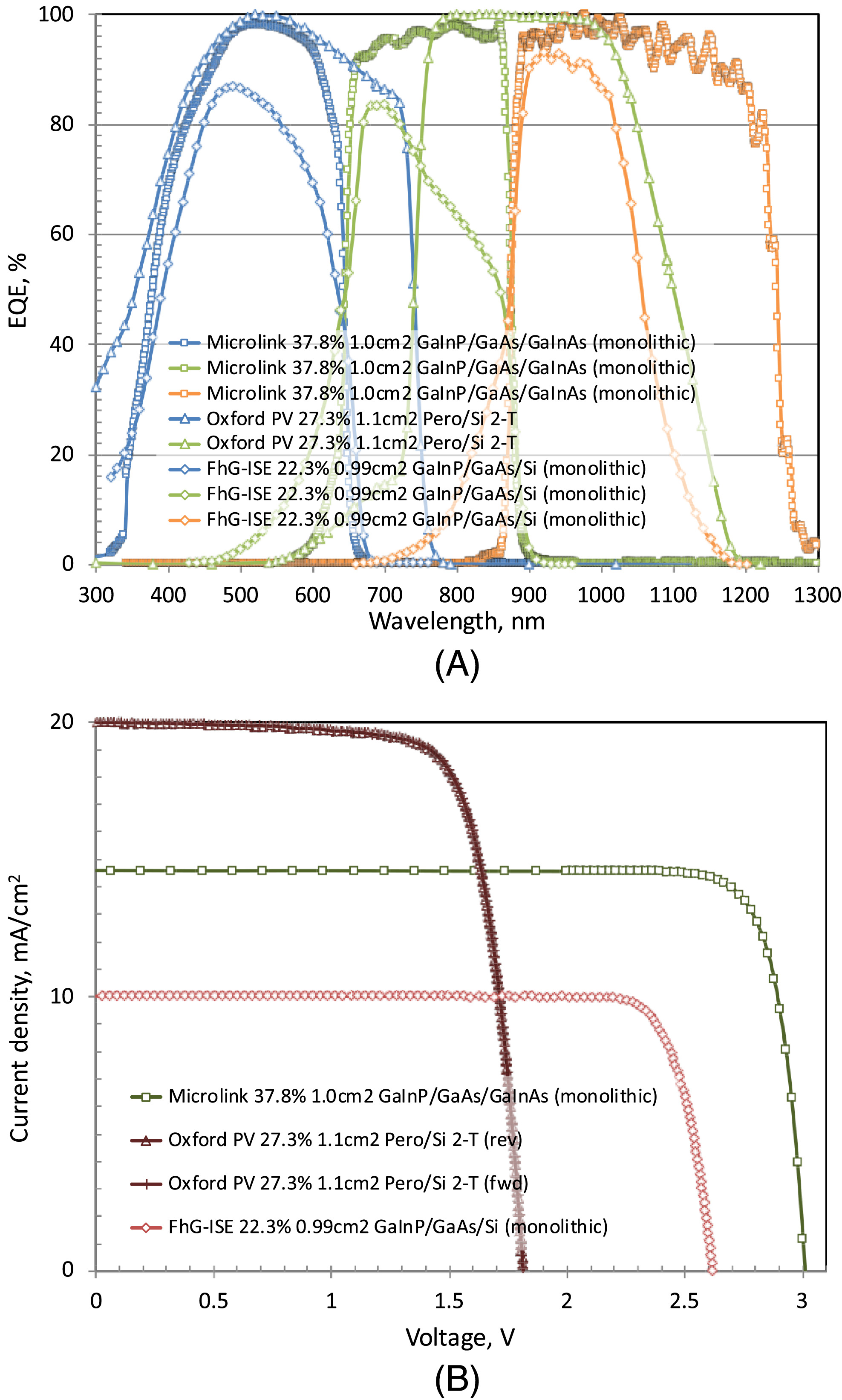
Three new results are reported in Table 3 relating to one‐sun, multijunction devices. The first is 23.3% for a 1‐cm2 monolithic, three‐junction, two‐terminal GaInP/GaAs/Si tandem device (monolithic, metamorphic, direct growth) fabricated and measured by the Fraunhofer Institute for Solar Energy Systems.39
The second new result reports the demonstration of an efficiency of 27.3% for a 1‐cm2perovskite/silicon monolithic two‐junction, two‐terminal device fabricated by Oxford PV40and again measured by Fraunhofer Institute for Solar Energy System. Note that this efficiency now exceeds the highest efficiency for a single‐junction silicon cell (Table 1), although for a much smaller area device.
A third new result for Table 3 is included as a multijunction cell “notable exception.” An efficiency of 37.8% was measured for a 1‐cm2 GaInP/GaAs/GaInAs monolithic three‐junction, two‐terminal cell fabricated by Microlink Devices44 and measured at NREL. The notable feature of this device is that it was fabricated using epitaxial lift‐off from a substrate that can be reused.44
Two new results appears in Table 5 (“concentrator cells and modules”). The first is 30.5% efficiency for a single junction GaAs concentrator cell fabricated and measured by NREL.
The second is a “notable exception”. An efficiency of 41.4% is reported for a 122‐cm2concentrator minimodule consisting of 10 glass acromatic lenses and 10 wafer‐bonded GaInP/GaAs, GaInAsP/GaInAs 4‐junction solar cells fabricated and measured by FhG‐ISE. This is the highest efficiency measured for such an interconnected concentrator module.
The EQE spectra for the new GaAs and CZTSSe cell results reported in the present issue of these tables are shown in Figure 1A, with Figure 1B showing the current density‐voltage (JV) curves for the same devices. Figure 2A shows the EQE for the new OPV cell and perovskite module results with Figure 2B showing their current JV curves. Figure 3A,B shows the corresponding EQE and JV curves for the new two‐junction, two‐terminal cell results.

A, External quantum efficiency (EQE) for the new GaAs and CZTSSe cell results reported in this issue; B, corresponding current density‐voltage (JV) curves for the same devices [Colour figure can be viewed at
wileyonlinelibrary.com]

A, External quantum efficiency (EQE) for the new OPV and perovskite cell results reported in this issue; B, corresponding current density–voltage (JV) curves [Colour figure can be viewed at
wileyonlinelibrary.com]

A, External quantum efficiency (EQE) for the new multijunction cell results reported in this issue (some results normalised); B, corresponding current density‐voltage (JV) curves [Colour figure can be viewed at
wileyonlinelibrary.com]
3 DISCLAIMER
While the information provided in the tables is provided in good faith, the authors, editors, and publishers cannot accept direct responsibility for any errors or omissions.
ACKNOWLEDGEMENT
The Australian Centre for Advanced Photovoltaics commenced operation in February 2013 with support from the Australian Government through the Australian Renewable Energy Agency (ARENA). The Australian Government does not accept responsibility for the views, information, or advice expressed herein. The work by D. Levi was supported by the US Department of Energy under Contract No. DE‐AC36‐08‐GO28308 with the National Renewable Energy Laboratory. The work at AIST was supported in part by the Japanese New Energy and Industrial Technology Development Organisation (NEDO) under the Ministry of Economy, Trade, and Industry (METI).