

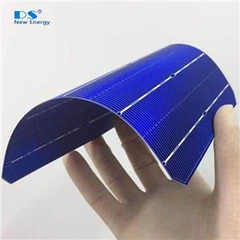


What this panel is: the DS flexible series is a frameless monocrystalline PERC module measuring 1660 × 990 × 1.4 mm and weighing 4.0 kg (2.4 kg/m²). It delivers 290–330 W at up to 19.8 % module efficiency, tolerates a static bending radius of 0.2 m, and is rated for −40 °C to +85 °C with an IP68 junction box and MC4-compatible connectors.
Why buyers specify this panel
Four numbers that decide whether a flexible module works in the field - not marketing claims.
4.0kg
Payload, not just freight
A 330 W glass module of the same footprint weighs 17–19 kg. At 4.0 kg this one gives you back roughly 14 kg per panel - the difference between adding a second array and reinforcing the roof. No frame also means no rail system and no through-deck fasteners.
0.2m radius
Conforms to real surfaces
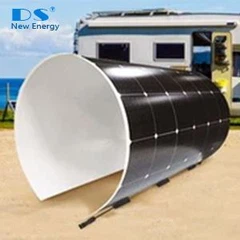
Rated for a static bend radius of ≥ 0.2 m - a typical RV roof crown or yacht coachroof. It is designed for a permanent curve, not repeated flexing: a single over-bend causes micro-cracks in the cells and permanent power loss.
19.8%
Glass-panel efficiency without glass
60 six-inch mono PERC cells in a 6 × 10 layout, laminated on an MWT back-contact PCB that removes front busbars. 330 W over 1.64 m² works out to 201 W/m² - the number that matters when deck area, not budget, is the constraint.
−0.36%/°C
Heat is where flexible panels lose
Power coefficient is −0.36 %/°C. At a realistic 65 °C cell temperature on a flush-mounted roof, a 330 W panel still delivers about 283 W. Anti-PID treated laminate, IP68 junction box, 1000 V DC system rating.
Full technical specifications
Electrical data at STC and NOCT, mechanical data and operating limits. All values apply to every wattage in the series unless stated otherwise.
Electrical data at STC
| Parameter | 290 W | 300 W | 310 W | 320 W | 330 W |
|---|---|---|---|---|---|
| Rated maximum power (Pmax) | 290 W | 300 W | 310 W | 320 W | 330 W |
| Open-circuit voltage (Voc) | 38.4 V | 38.8 V | 39.2 V | 39.6 V | 40.0 V |
| Maximum power voltage (Vmp) | 31.2 V | 31.6 V | 32.0 V | 32.4 V | 32.8 V |
| Short-circuit current (Isc) | 9.50 A | 9.66 A | 9.82 A | 9.98 A | 10.14 A |
| Maximum power current (Imp) | 9.30 A | 9.50 A | 9.69 A | 9.88 A | 10.08 A |
| Module efficiency | 17.6 % | 18.3 % | 18.9 % | 19.5 % | 19.8 % |
| Power tolerance | 0 / +5 W | ||||
STC: irradiance 1000 W/m², cell temperature 25 °C, AM 1.5 G.
Electrical data at NOCT
| Parameter | 290 W | 300 W | 310 W | 320 W | 330 W |
|---|---|---|---|---|---|
| Rated maximum power (Pmax) | 216 W | 224 W | 232 W | 240 W | 248 W |
| Open-circuit voltage (Voc) | 35.5 V | 35.7 V | 35.9 V | 36.1 V | 36.3 V |
| Maximum power voltage (Vmp) | 28.5 V | 28.9 V | 29.3 V | 29.7 V | 30.3 V |
| Short-circuit current (Isc) | 7.65 A | 7.85 A | 8.04 A | 8.22 A | 8.41 A |
| Maximum power current (Imp) | 7.58 A | 7.76 A | 7.93 A | 8.09 A | 8.27 A |
NOCT: irradiance 800 W/m², ambient temperature 20 °C, wind speed 1 m/s.
Mechanical data
| Dimensions (L × W × H) | 1660 × 990 × 1.4 mm |
| Weight | 4.0 kg · 2.4 kg/m² |
| Cell configuration | 60 cells (6 × 10) · monocrystalline PERC · 6 inch |
| Encapsulant | EVA |
| Front sheet | ETFE or PET - confirm specification |
| Backsheet options | White · transparent · black |
| Frame | None (frameless laminate) |
| Junction box | IP68 |
| Cable | 4 mm² · length made to order |
| Connector | MC4 compatible |
Operating conditions and temperature coefficients
| Maximum system voltage | 1000 V DC (IEC) |
| Maximum series fuse rating | 15 A |
| Operating temperature range | −40 °C to +85 °C |
| Static bending radius | ≥ 0.20 m |
| Temperature coefficient of Pmax (γ) | −0.36 %/°C |
| Temperature coefficient of Voc (β) | −0.28 %/°C |
| Temperature coefficient of Isc (α) | +0.06 %/°C |
Values are typical production values. A signed datasheet with the serial-number flash-test report accompanies every shipment.
Dimensions, bending and mounting
The three specification mistakes that cause field failures on flexible arrays.

Bend across the short edge, once, at design stage
At 1.4 mm the laminate will follow a 0.2 m radius, which covers most RV roof crowns and yacht coachroofs. Two rules matter: bend along the long axis so the 990 mm dimension wraps the curve, and set the arc during installation - flexible panels are not designed to be flexed repeatedly. A single bend tighter than 0.2 m cracks cells permanently, and the loss is usually invisible until you flash-test the module.
Leave an air gap - it is worth 5–8 % of output
Flush-bonded panels run 20–25 °C hotter than ventilated ones. With a −0.36 %/°C coefficient, that alone costs 7–9 % of annual yield. Raise the panel on 10–15 mm corflute or EPDM strips, or bond only along the perimeter and let the centre breathe.

Bond, don't bolt - unless the substrate needs fasteners
On fibreglass, aluminium and painted steel, marine-grade VHB tape or Sikaflex 291i along a prepared, solvent-wiped surface is sufficient and avoids every leak path. On fabric canopies and thin composite panels, use the grommet positions instead. Confirm grommet/hole pattern and pull-off test data
Electrical integration: 12 V, 24 V and string limits
The most common pre-sales question on a 330 W panel is which controller it needs. Here is the arithmetic.
Match the controller to Vmp, not to Pmax
Vmp is 32.8 V on the 330 W version. On a 24 V battery bank a PWM controller can work, but an MPPT typically recovers 25–30 % more energy because it lets the array run at 32.8 V instead of clamping it to battery voltage. On a 12 V bank PWM throws away roughly 60 % of the array - MPPT is not optional there. A 330 W panel needs a 30 A MPPT at 12 V (≈25 A) and a 15 A MPPT at 24 V (≈12 A).
Two in series on a 100 V controller. Not three.
Voc rises 0.28 %/°C as temperature falls. At −10 °C a 330 W panel reaches 43.9 V; two in series is 87.8 V, comfortably inside a 100 V MPPT limit. Three in series reaches 132 V and destroys the controller on the first cold morning. Series-connect at most two per string, fuse each string at 15 A, then parallel the strings.
Derating you should plan for
Budget 75–80 % of nameplate for real-world annual yield in a temperate climate: 248 W at NOCT, minus soiling and cable losses, plus the air-gap gain. A 330 W panel realistically returns about 1.1–1.3 kWh/day in summer at 40° latitude on a tilted surface.
Where this panel is used

RV, campervan and motorhome roofs
No drilling means no water ingress warranty claims on the vehicle. 4.0 kg per panel keeps you inside payload limits, and the 0.2 m bend follows the roof crown without a mounting frame. For a typical 12 V camper, two 330 W panels in parallel with a 40 A MPPT covers a 200 Ah lithium bank with margin.
semicoYachts, sailboats and workboats
Weight aloft and windage both matter, and a 4 kg panel mounted on a bimini or coachroof changes neither. Two marine-specific points: the connector, not the laminate, is the usual failure point - use IP67-rated MC4 mating pairs with dielectric grease - and salt mist is a separate test from IP rating. Specify IEC 61701 salt-mist certification if the array sees spray. State IEC 61701 test level if held

Off-grid, telecom and monitoring sites
Where structures are lightweight or access is difficult, 201 W/m² on a bonded surface avoids ballast and penetrations. Two panels in series suits a 24 V or 48 V MPPT input.

Light commercial and agricultural roofs
On trapezoidal metal or ageing membrane roofs with limited load capacity, adhesive mounting avoids both the rail system and the structural survey. Confirm the roof can take the wind uplift load before specifying.
Flexible vs rigid glass panel
A flexible module is not a cheaper glass module. It solves a different problem - and it loses on two metrics you should know about before you commit.
| Metric | This flexible panel | Glass-framed module |
|---|---|---|
| Weight per m² | 2.4 kg/m² | 10–12 kg/m² |
| Thickness | 1.4 mm | 30–35 mm + frame |
| Mounting | Adhesive, no penetrations | Rails, clamps, roof penetrations |
| Curved surfaces | Yes, ≥ 0.2 m radius | No |
| Wind / snow load rating | Bonded area dependent | 2400 / 5400 Pa certified |
| Module efficiency | 17.6–19.8 % | 21–23 % |
| Expected service life | 10–15 years (fluoropolymer front sheet) | 25–30 years |
| Cost per watt | Higher | Lower |
Choose flexible when weight, curvature, or the inability to penetrate the substrate is the binding constraint. Choose glass when you have flat area, structural capacity and a 25-year horizon.
Laminate construction and materials
The front sheet determines service life more than any other component. It is the first thing a technical buyer asks about.
precautions for product use
Lorem ipsum dolor sit, amet consectetur adipisicing elit.
What the laminate is made of
- 60 × mono PERC cells, 6 inch, 6 × 10 layout
- MWT back-contact PCB carrier - no front busbars
- EVA encapsulant, vacuum-laminated
- Front sheet: ETFE / PET - confirm
- Backsheet: white, transparent or black
- IP68 junction box, bypass diodes integrated
- 4 mm² cable, length to order
- MC4-compatible connectors
- Anti-PID treatment on cells and laminate
- No frame, no glass - 1.4 mm total
Quality control and certification
Standards held, not logos displayed. Buyers and customs both check these.
- IEC 61215 - design qualification and type approval cert no.
- IEC 61730 - module safety qualification cert no.
- IEC 61701 - salt mist corrosion test level
- ISO 9001:2015 - quality management
- ISO 14001:2015 - environmental management
- ISO 45001:2018 - occupational health & safety
- CE / UKCA declaration of conformity
- TÜV NORD certification scope
What we test before packing
Every module is flash-tested and power-binned to 0/+5 W, then electroluminescence-inspected for micro-cracks after lamination - the failure mode flexible panels are most exposed to. A serial-numbered test report travels with the shipment.
Warranty
Two separate warranties. Ask for both documents - they cover different failures.
| Cover | Term | Covers |
|---|---|---|
| Product warranty | 5 years | Delamination, junction box, connectors, manufacturing defects |
| Performance warranty | 10 years | Power output ≥ 80 % of nameplate confirm curve |
Claims handled against the serial-numbered flash-test report and installation photographs. Insert your actual terms and claim process
OEM / ODM and customisation
What can be changed, and what it costs you in lead time.
- Wattage within the 290–330 W window
- Panel dimensions to drawing
- Backsheet colour: white / transparent / black
- Logo laminated into the front sheet
- Logo and spec label printing

- Cable length and connector type
- Junction box position
- Retail carton and pallet branding
- Pre-drilled grommet positions
- Sample orders before tooling sample policy
Products Description
300W 310W 320W 330W Flexible Solar Panel
Ultra-Flexible Design
This flexible solar panel adopts durable polymer material, supports curved surface installation, and is ultra-thin and rollable for wide scenarios.


High-Efficiency Output
With monocrystalline cells up to 19.8% efficiency, it delivers stable 300W–330W power and strong heat resistance for high yield.
Easy & Reliable Use
Lightweight structure cuts installation cost greatly; IP68 junction box ensures safe, long-lasting operation in harsh environments.

|
Cell |
Mono |
|
No. of cells |
60 (6×10) |
|
Rated Maximum Power(Pmax) |
330W |
|
Maximum Efficiency |
19.8% |
|
Junction Box |
IP68 |
|
Maximum System Voltage |
1000V DC |
|
Operating Temperature |
-40℃~+85℃ |
Product description
This series of solar panels is featured with flexible and high power up to 320W and 300W .
Our flexible Solar Panels are made by high-efficiency solar cells onto a thin layer of extremely durable polymer material. This allows them to be thinner and lighter than our rigid solar panels while also giving them the ability to be mounted on surfaces that aren't completely flat. The flexible solar panels can be used for your RV, boat,van, yacht, sailboat, houseboat, trawler or commercial boat wtih quick install.
Key features
Flexible
Flexible polymer materials and MWT PCB packaging technology.
High efficiency
The highest efficiency of the series is up to 19.5%.
Ultra thin
The PV Module thickness is only 1.4mm.
Light weight
Weight is reduced by more than 70%.
Easy Installation
Installation cost is reduced by about 50%.
Attractive design
Specially designed grid feature, nice-looking.
Heat-Resistant
Temperature efficiency is low to -0.36%/°C. More power output in hot environment.
Anti-PID
With specific treatment, PV module passed strict PID test, no PID risk.

Dimension of PV module
Electrical data at STC
|
Rated Maximum Power(Pmax) [W] |
290 |
300 |
310 |
320 |
330 |
|
Open Circuit Voltage(Voc) [V] |
38.4 |
38.8 |
39.2 |
39.6 |
40.0 |
|
Maximum Power Voltage(Vmp) [V] |
31.2 |
31.6 |
32.0 |
32.4 |
32.8 |
|
Short Circuit Current(Isc) [A] |
9.50 |
9.66 |
9.82 |
9.98 |
10.14 |
|
Maximum Power Current(Imp) [A] |
9.30 |
9.50 |
9.69 |
9.88 |
10.08 |
|
Module Efficiency [%] |
17.6 |
18.3 |
18.9 |
19.5 |
19.8 |
|
Power Tolerance |
0~+5W |
||||
|
Temperature Coefficient of Isc(α_Isc) |
0.06%/℃ |
||||
|
Temperature Coefficient of Voc(β_Voc) |
-0.28%/℃ |
||||
|
Temperature Coefficient of Pmax(γ_Pmp) |
-0.36%/℃ |
||||
|
STC |
Irradiance 1000W/m², cell temperature 25℃, AM1.5G |
||||
Electrical data at NOCT
|
Rated Maximum Power(Pmax) [W] |
216 |
224 |
232 |
240 |
248 |
|
Open Circuit Voltage(Voc) [V] |
35.5 |
35.7 |
35.9 |
36.1 |
36.3 |
|
Maximum Power Voltage(Vmp) [V] |
28.5 |
28.9 |
29.3 |
29.7 |
30.3 |
|
Short Circuit Current(Isc) [A] |
7.65 |
7.85 |
8.04 |
8.22 |
8.41 |
|
Maximum Power Current(Imp) [A] |
7.58 |
7.76 |
7.93 |
8.09 |
8.27 |
|
STC |
Irradiance 800W/m², ambient temperature 20℃, wind speed 1m/s |
||||
Current-voltage curves

Mechanical data
|
Dimension (LxWxH) |
1660mmx990mmx1.4mm |
|
Weight |
4.0 Kg |
|
Back material |
Backplane (white, transparent, black) |
|
Cell (quantity / material / type / dimensions) |
60 (10x6) / Monocrystalline PERC / 6inch |
|
Encapsulant (material) |
EVA |
|
Frame |
None |
|
Junction box (protection degree) |
IP68 |
|
Cable (length / cross section area) |
Customized by customer / 4mm2 |
|
Connector |
MC4 compatible |
Certification

✓ ISO 9001: 2005 Quality Management System
✓ ISO 14001: 2014 Environment Management System
✓ QHSAS 18001: 2007 Occupation Health Safety Management System
✓ TUV NORD Certification
Operating conditions
|
Max. system voltage |
DC 1000V (IEC) |
|
Max. series fuse rating |
15A |
|
Operating temperature range |
-40℃~+85℃ |
|
Bending radius |
≥ 0.20m |
Certificate

Hot Tags: 300w 310w 320w 330w flexible solar panel, China, suppliers, manufacturers, factory, made in China


