








From thegrid.rexel.com
The Atmospheric Science Data Center by NASA is a very valuable web resource when estimating the energy production of a projected solar PV system, as well as for determining the optimal tilt angle of the system to maximize energy production over the year. Basically, the database allows the user to input the exact geographic coordinates where a project will be located, and provides a wealth of information regarding available solar irradiation.
Accessing the Database
The address for the Surface Meteorology and Solar Energy Database is:
https://eosweb.larc.nasa.gov/sse/
In order to access specific information for solar PV systems, go to Meteorology and Solar Energy in the Data Retrieval section, and then click on Data Tables for a particular location:

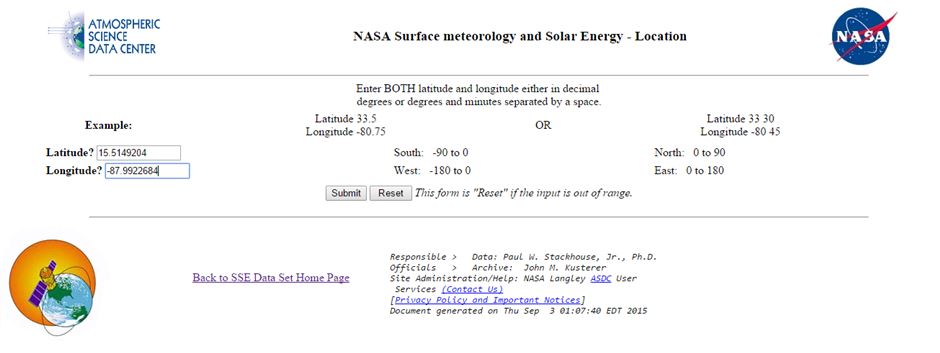
Entering Coordinates
In order to provide the exact data tables for a particular location, the database requires the latitude and longitude. Once the coordinates have been input, click on Submit. In this example, the coordinates used are:
· Latitude: 15.5149204
· Longitude: -87.9922684
Using the Database
Once the database opens, a large selection of available data is displayed. The following screenshot only displays a small section:

For typical solar photovoltaic installations, the section that provides the most relevant information is Parameters for Tilted Solar Panels. Multiple fields can be selected at once by holding down Ctrl while clicking on them. After the desired fields are selected, press submit.
Radiation on Equator-Pointed Tilted Surfaces
The following table is very useful since it shows the available daily radiation in kWh/m2 according to tilt angle. Most importantly, it displays the optimal tilt angle (OPT ANG) that will maximize solar PV system output over the year. In the location in this example, the optimal tilt angle for solar PV systems is 18.6° southward. The average energy available by optimizing the tilt angle is 5.27 kWh/m2/day. It is also possible to analyze the available radiation on a month-by-month basis.

Of course, it is not possible to convert 100% of this energy into usable electric power. All solar photovoltaic panels have a conversion efficiency, which at the moment is of 20% or below for most commercial PV cells. The actual energy obtained will be the product of:
ENERGY OUTPUT (kWh/day) = AREA OF PV ARRAY (m2) x CONVERSION EFFICIENCY (%) x AVAILABLE ENERGY (kWh/m2/day)
NASA's database is a useful and quick reference when the average solar radiation at a specific location or the optimal tilt angle for solar panels is required.