
Source: instylesolar
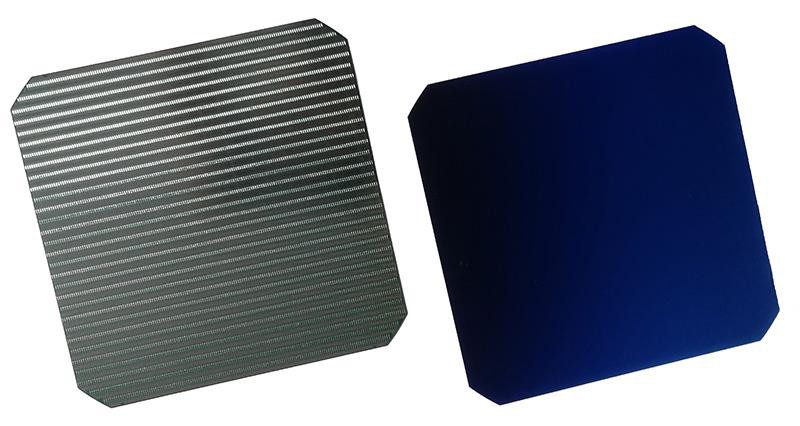
How Do IBC Cells Work
Interdigitated Back Contact (IBC) cells may be one of the most complicated technologies used to fabricate solar panels, but it also offers efficiency values that cannot be ignored, which is why it is considered an important alternative today.
Traditional solar cells achieve energy conversion by placing front contacts in the cell. This means photons that reach the surface of the cell must be absorbed at that moment to release electrons and produce electricity.
If they are not absorbed they are transmitted or reflected. This can be considered a loss.
IBC cells implement a different idea. Instead of placing the contacts in the front of the cell, they place them on its rear side.
This allows them to achieve higher efficiency due to reduced shading on the front of the cell, while at the same time electron-hole pairs generated by the absorbed light can still be collected on the rear side of the cell.
On the illustration below you can take a look at the structure of IBC cells, from a rear side point of view.

The Benefits of IBC Cells Compared to Al-BSF
Lower Shading Losses
First and most important is that the shading loss caused by the front side electrode (contact) is nil, which allows gains between 5-7% to be achieved in the generated current.
Lower Series Resistance
Moreover, as you can see in the illustration above, the contacts on the rear side occupy a larger area.
This is associated with a much lower series resistance due to the fact that the space between the contacts is insignificant when compared to a conventional solar cell.
It is only possible to do this with rear side contact cells as there is no need to leave a wider space opened in the front side for light absorption.
This is a really interesting feature when considering concentrated PV (CPV) cells where the effect of series resistance is hugely important.
Independence Between Optical and Electrical Optimisation
There is a great advantage in decoupling the optical optimisation from the electrical optimisation.
In traditional solar cells, there has to be a limited trade between the series resistance, the recombination losses, the absorption of light, efficiency and high open circuit voltages, as both the electrical conduction and energy conversion are performed in the front side.
In IBC cells, the two functions are independent of each other. The optical optimisation is performed on the front side, while the electrical optimisation is performed on the back side.
Why IBC Cells Are More Complicated:
The current flow of carriers is done in two-dimensions, while on standard cells it is only one dimension.
The efficiency of the IBC cell is deeply related to the BSF lifetime and the front surface recombination, demanding higher quality silicon wafers with a longer carrier lifetime.
Alignment of n-type and p-type regions on the same side of the wafer (rear side) is more complicated.
Sophisticated cleaning procedures and superior contamination control is necessary for the manufacturing process.