Products Description
Bifacial 182mm M10 Monocrystalline PERC Solar Cell
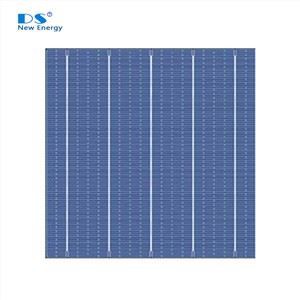
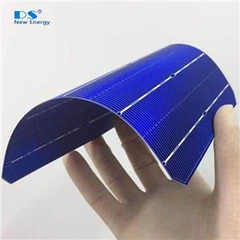
The DSNeg 182mm M10 bifacial PERC cell is a 10-busbar (10BB) double-side generator for module manufacturers building 545 W-class half-cut modules. Built on the 182mm M10 wafer platform with laser SE and PERC rear passivation, it delivers up to 7.58 W at 23.0% efficiency in 12 power bins (21.9–23.0%) - matched to your module's target wattage and price point, from a single factory source.
Laser SE combined with PERC technology makes this 182mm solar cell rated power up to 7.58W at 23% efficiency. 72 pieces of these cells combined with half-cut technology make solar panels with power up to 545 watt - high power panels that help lower the BoS cost of any solar PV system.
Product Introduction
| QUICK SPECIFICATIONS | |
| Type | Monocrystalline solar cell, bifacial P-type PERC |
| Dimension | 182 ± 0.25 mm × 182 ± 0.25 mm (corner to corner Φ 247 ± 0.25 mm) |
| Shape | Pseudo-square with rounded corners |
| Thickness | 180 ± 30 μm |
| Busbars | 10 front / 10 back (MBB, laser SE) |
| Rated cell power (Pmax) | 7.23 – 7.58 W (12 power bins) |
| Maximum Efficiency | 23.0% (bin 1) |
| Module match | 72 cells + half-cut → up to 545 W panel |
| Peel strength | > 1 N/mm |
| Temperature coeff. (Pmax) | −0.353 %/°C |

Key Features
Cell procurement is a yield decision: every bin you buy becomes stringing labor, solder joints and lamination cycles. This 182mm bifacial cell is specified for consistency, solderability and clean half-cut processing on MBB lines.
Why M10: The Cell-to-Module Math
Your module's cost is not only the cell price. It is the cells per module, the stringing labor, the solder joints, the lamination time and the transport weight. The 182mm M10 platform moves you up the wattage ladder with fewer cells per frame.
| Module design | Cells (full) | Half-cut positions | Max module power | Typical application |
|---|---|---|---|---|
| 455W class | 60 | 120 | ≈455 W | Distributed / residential-plus C&I |
| 545W class | 72 | 144 | up to 545 W (datasheet) | Commercial rooftop, C&I |
Module design examples calculated from bin-1 cell output of 7.58 W; final module power depends on your layout, stringing and lamination.
Where the savings land
Cell Technology
Four process layers stack on a single 182mm wafer. Each one is a measurable contribution to the 23.0% bin-1 efficiency and the consistency across 12 bins.
Technology First
We offer a variety of transmission components
Laser SE (laser screen-printed emitter)
Laser processing sharpens the front emitter junction profile beyond conventional diffusion: a finer, more uniform junction raises efficiency and tightens the spread between cells - exactly what the 12-bin sorting then monetizes for you.
PERC rear passivation
The rear face carries a passivation stack (anti-PID SiO&sub2; plus Al&sub2;O&sub3;/SiNx) that reflects light back into the cell and suppresses carrier recombination - the core efficiency step of PERC versus standard monocrystalline.
Bifacial rear Al grid lines
Unlike single-side cells, this cell carries a rear aluminum grid that collects minority-carrier current from the back face. The result is genuine double-side generation: the module's back glass becomes an active surface.
10-busbar, both sides
10 busbars front and back multiply the current paths, shorten each one and cut resistive loss. For half-cut processing, each 182 × 91 mm half is a clean, low-ohm string segment with proven solderability (peel strength > 1 N/mm).
| TEMPERATURE COEFFICIENTS & SOLDERABILITY | |
| Tk Uoc | −0.297 %/K |
| Tk Isc | +0.06 %/K |
| Tk Pmax | −0.353 %/K |
| Peel strength (minimum) | > 1 N/mm |

PERC vs Bifacial PERC cell structure: the rear Al grid lines are what make this cell a double-side generator.

BiPERC process flow: from wafer texturing through diffusion, rear passivation, printing, co-firing to anti-LID hydrogenation.
Technical Specifications
Every cell is flash-tested and sorted into one of 12 power bins by measured output, so each batch you receive sits inside a narrow, guaranteed window.
Electrical parameters at STC
| Bin | Eff (%) | Pmpp (W) | Vmp (V) | Imp (A) | Voc (V) | Isc (A) | FF (%) |
|---|---|---|---|---|---|---|---|
| 1 | 23.0 | 7.58 | 0.596 | 12.725 | 0.692 | 13.338 | 82.17 |
| 2 | 22.9 | 7.55 | 0.595 | 12.691 | 0.691 | 13.311 | 82.10 |
| 3 | 22.8 | 7.52 | 0.594 | 12.669 | 0.690 | 13.288 | 82.08 |
| 4 | 22.7 | 7.49 | 0.593 | 12.637 | 0.689 | 13.258 | 82.04 |
| 5 | 22.6 | 7.46 | 0.592 | 12.604 | 0.688 | 13.221 | 82.03 |
| 6 | 22.5 | 7.43 | 0.591 | 12.570 | 0.687 | 13.187 | 82.00 |
| 7 | 22.4 | 7.40 | 0.590 | 12.535 | 0.686 | 13.147 | 82.00 |
| 8 | 22.3 | 7.36 | 0.589 | 12.500 | 0.685 | 13.108 | 82.00 |
| 9 | 22.2 | 7.33 | 0.588 | 12.465 | 0.684 | 13.068 | 82.00 |
| 10 | 22.1 | 7.30 | 0.587 | 12.430 | 0.683 | 13.028 | 82.00 |
| 11 | 22.0 | 7.26 | 0.586 | 12.395 | 0.682 | 12.998 | 81.94 |
| 12 | 21.9 | 7.23 | 0.585 | 12.360 | 0.681 | 12.968 | 81.88 |
STC: irradiance 1000 W/m², cell temperature 25°C, AM1.5G. Bin 1 highlighted. All 12 bins from the DSNeg cell datasheet.
Mechanical Data
| MECHANICAL & DESIGN DATA | |
| Dimension | 182 ± 0.25 mm × 182 ± 0.25 mm |
| Length (corner to corner) | Φ 247 ± 0.25 mm |
| Shape | Pseudo-square with rounded corners |
| Thickness | 180 ± 30 μm |
| Front | 10 busbars (MBB, laser SE) |
| Back | 10 busbars (MBB, bifacial rear Al grid) |
| Peel strength (minimum) | > 1 N/mm |
| Half-cut size (after cutting) | 182 × 91 mm per half (typical M10 half-cut) |
Quality Control & Supply
The quality story of a cell supplier is the process between the diffusion furnace and your loading dock. Here is what happens to this cell before it reaches you:

Cell production and module lines at the DSNeg factory.
Applications
This cell is the raw material for a specific set of high-wattage module designs. If your product line matches one of these three, the 182mm M10 bifacial cell is the spec.
545W-class C&I rooftop modules
72 cells, 144 half-cut positions, double-glass bifacial module for warehouses, factories and commercial roofs where W/m² and BoS decide the bid.
• Up to 545 W per module (datasheet)
• Bifacial rear gain on bright rooftops
• 10BB printing, standard half-cut line
455W-class distributed modules
60-cell designs for distributed and residential-plus projects that still want the efficiency and low-light behavior of the M10 PERC platform.
• ≈455 W at bin-1 cell output
• Lighter frame, easier logistics
• Same bin structure as the 545W line
Your private-label module program
EPCs and distributors running their own lamination: qualify the cell with samples, then supply your branded modules from a factory-direct cell source.
• Sample cells for full line qualification
• Stable bins for consistent module output
• M12 210mm cells available for 600W+ lines
Complete the cell family - other DSNeg monocrystalline PERC cells:
Bifacial 210mm M12 PERC Cell9BB 166mm Monocrystalline CellP-Type Full Square Cell
Frequently Asked Questions
Direct answers for cell procurement and process engineering teams. If your question is not covered here, our sales engineers respond within one business day.
Get a Factory-Direct Cell Quote
Get the cell datasheet & a factory-direct quote
Tell us your bins, monthly cell volume and destination port. We reply within one business day with pricing per bin, the full cell datasheet (including per-bin bifaciality data) and a lead-time plan for your lamination schedule.
Phone: +86-571-56772663 | Email: info@dsneg.com | WhatsApp: +86 181 5812 1992
Hot Tags: bifacial 182mm m10 monocrystalline perc solar cell, China, suppliers, manufacturers, factory, made in China