Product Overview
A portable Electroluminescence (EL) tester is designed to detect various internal and external defects in photovoltaic (PV) cells and modules, including microcracks, broken cells, soldering defects, dark cells, finger interruptions, and cell mismatch.
Internal defects in PV cells and modules can significantly affect their service life, long-term power generation performance, and operational reliability. In severe cases, defective modules may even create potential safety hazards, including fire risks. Therefore, accurate EL inspection is an important part of PV module quality control and power plant operation and maintenance.
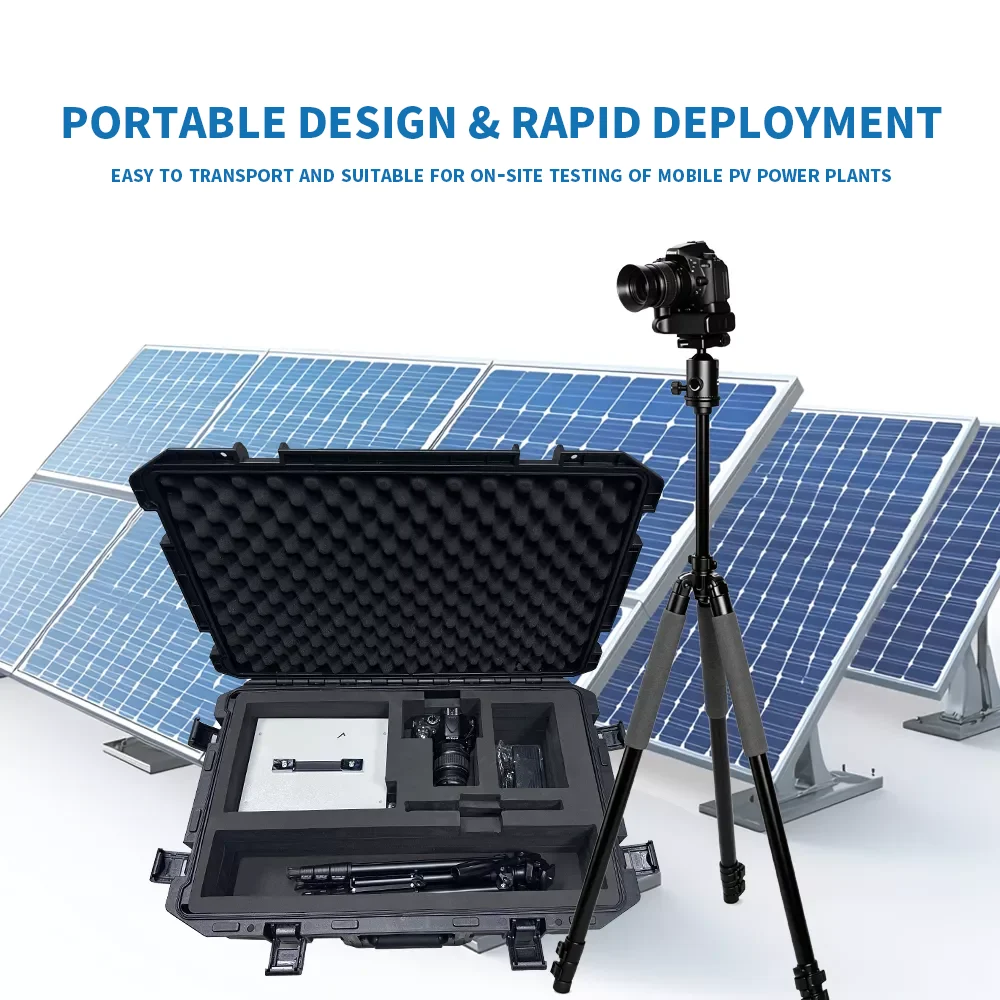
Portable EL testing equipment is developed to meet the requirements of on-site EL inspection for photovoltaic power plants. Its compact and portable design allows quick installation and operation under a variety of complex site conditions. The system can rapidly identify EL defects in PV modules and provide important technical data for PV module installation, operation and maintenance (O&M), quality inspection, and power plant performance assessment.
Key Features
1. Portable Design
The complete system is lightweight, compact, and easy to transport, assemble, and deploy at different inspection sites.
2. Automatic Focusing
The imaging system supports fully automatic focusing, including focusing under low-light conditions, enabling fast and accurate image acquisition without complicated manual adjustment.
3. Advanced Light Filtering
The optical system can effectively filter out interference from artificial lighting, moonlight, and other ambient light sources, helping maintain consistent EL imaging quality under different field conditions.
4. Portable EL Power Supply
The portable EL power supply is equipped with a high-performance lithium battery and a compact, lightweight design. Key functions include:
LED battery level display
Wireless remote power control
Power-on indicator
Short-circuit protection
Constant-current output module
Stable voltage and current output regardless of battery charge level
More than 200 module tests per charge, depending on operating conditions
These functions help meet the power requirements of large-scale on-site EL inspection.
5. Carbon-Fiber Inspection Tripod
The dedicated carbon-fiber support system combines high structural stability with lightweight construction. Its telescopic design allows convenient adjustment, folding, and transportation.
6. Positioning System
A dedicated positioning device enables rapid alignment with the inspection area, significantly improving testing efficiency and positioning accuracy during on-site module inspection.
7. Data Management Software
The software provides a comprehensive set of functions for EL inspection data management, including:
User access control
Password-protected operation
Data statistics
Image processing
Barcode entry
Date-based classification
Defect classification
File naming and storage
Image watermarking
Data export
Data logging
These functions provide a more professional and efficient workflow for PV module EL inspection and defect management.
Technical Specifications
| System | Item | Specification |
|---|---|---|
| Imaging System | Camera Resolution | 24 MP; 6000 × 4000; 300 dpi; automatic focusing |
| Image Sensor | CMOS | |
| Sensor Size | 23.5 × 15.6 mm | |
| Infrared Lens | Dedicated variable automatic-focus lens, 50 mm or 35 mm | |
| Imaging Time | 0.1–30 s, adjustable according to image quality | |
| ISO Sensitivity | ISO 100–12800, adjustable according to image quality | |
| Maximum Inspection Resolution | 0.2 mm/pixel | |
| Wi-Fi Module | 2.4 GHz; high-speed data transmission with interference resistance | |
| Camera Display | 3.2-inch rotatable LCD; 1.04 MP | |
| Focusing Mode | Fully automatic; 11-point planar focusing; supports automatic focusing under low-light, inclined-surface, and dark conditions without additional lighting or manual intervention | |
| Light Filtering | Filters interference from artificial lighting, moonlight, starlight, and other ambient light sources | |
| Tablet | Compatible with Huawei / Xiaomi / Apple tablets | |
| Software System | APP Software (Wi-Fi Version) | Connection: Wireless Wi-Fi; Transmission time: 1–3 s; Functions: remote image capture control, image viewing, original image download, image storage, etc. |
| Data Management | Data entry, date-based classification, defect classification, file naming and storage, image watermarking, data export, data logging, etc. | |
| Data Storage | 1. Camera memory card 2. Tablet photo gallery 3. Computer file manager, with customizable storage path | |
| EL Power Supply Module | Portable EL Power Supply | Power supply: Self-powered; Capacity: 10 Ah; Applicable module power: 100–1000 W; Functions: LED battery level display, wireless remote/manual power-on control, power-on indicator, stable constant-current output module, short-circuit/reverse-current/leakage/overload/overheating protection; Remote control distance: 20 m wireless; Power connection: MC4 connector; Weight: 3 kg |
| Support System | Tripod | 2.4 m dedicated carbon-fiber inspection tripod + 720° pan-tilt head (optional) |
| Complete System | Carrying Case | Dimensions: 560 × 435 × 262 mm; Weight: 10 kg |
| Operating Temperature | Ambient Temperature | -30°C to 50°C |
| Service & Warranty | Warranty & Technical Support | Warranty period: 1 year; Technical support response within 1 hour; 24/7 telephone support and technical solutions |
Software Functions
The inspection software is designed to support a complete EL testing workflow, from image acquisition and defect identification to data classification and export.
Key functions include:
User access management
Password protection
Remote camera control
Image viewing
Original image download
Image storage
Data entry
Date-based data classification
Defect classification
Image naming and archiving
Image watermarking
Data export
Data logging
This enables systematic management of EL images, module inspection records, and defect information, which is particularly useful for large-scale PV module inspection and power plant O&M.
Configuration List
| No. | Module | Item | Specification | Quantity | Unit |
|---|---|---|---|---|---|
| 1 | Imaging | EL Camera | 24 MP; 6000 × 4000; automatic focusing | 1 | Set |
| 2 | Imaging | Infrared Lens | 50 mm / 35 mm, one of the two | 1 | Pc |
| 3 | Imaging | SD Memory Card | 32 GB / 120 MB | 1 | Pc |
| 4 | Imaging | Camera Battery | Dedicated lithium battery | 3 | Pcs |
| 5 | Imaging | Charger | Dedicated charger | 1 | Set |
| 6 | Imaging | Data Cable | Dedicated high-speed data transmission cable, 3 m | 1 | Pc |
| 7 | Imaging | Tablet | 10.4-inch tablet, 6 GB / 128 GB | 1 | Set |
| 8 | EL Power Supply | Portable EL Power Supply | 10 Ah | 1 | Set |
| 9 | EL Power Supply | Power Fuse | 15 A | 5 | Pcs |
| 10 | EL Power Supply | Charging Adapter | Dedicated power charging adapter | 1 | Pc |
| 11 | EL Power Supply | Module Power Cable | 5 m, dedicated MC4 connector cable | 1 | Pc |
| 12 | EL Power Supply | DC Power Supply | 100 V / 10 A DC power supply | 1 | Set |
| 13 | EL Power Supply | DC Power Supply | 1000 V / 10 A DC power supply | 1 | Set |
| 14 | Multi-purpose | Cable Reel | 50 m multi-purpose cable reel | 1 | Set |
| 15 | Support | Support Stand | 1.4 m / 2.4 m / 3 m | 1 | Set |
| 16 | Complete System | Instrument Carrying Case | Trolley-style case with handle and wheels | 1 | Pc |
| 17 | Support | Tripod | Dedicated carbon-fiber inspection tripod, 1.4 m or 2.4 m | 1 | Pc |
| 18 | Software | APP Software | Wi-Fi version | 1 | Set |
| 19 | Others | Accessories & Documents | USB flash drive, user manual, warranty card, certificate of conformity, packing list | 1 | Set |
Application in PV Module Quality Inspection
EL inspection is widely used as a non-destructive testing method for photovoltaic cells and modules. By applying a forward current to a PV module and capturing the emitted infrared electroluminescence image, internal defects that may not be visible under conventional visual inspection can be identified.
Typical defects detectable through EL testing include:
Cell microcracks
Broken cells
Inactive areas
Soldering defects
Finger interruptions
Dark or inactive cells
Cell mismatch
Potential manufacturing and handling defects
For PV power plants, portable EL testing equipment is particularly useful for incoming module inspection, installation acceptance, troubleshooting, periodic O&M inspections, quality assessment, and defect diagnosis. Early identification of internal defects can help reduce potential power losses and improve the long-term reliability of photovoltaic systems.